

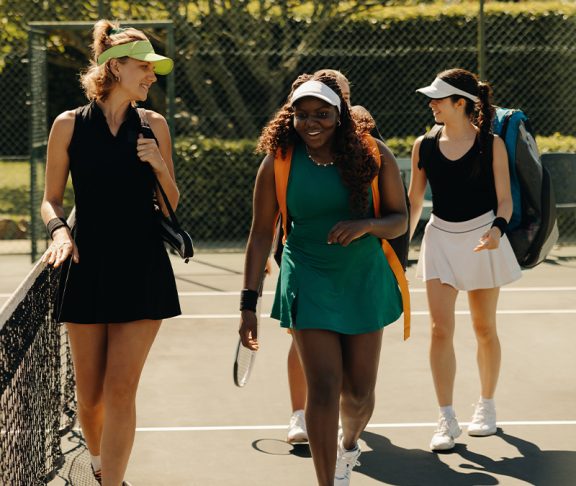
Tennis is a sport enjoyed by more than 27 million people in the United States alone. Its unique bounty of benefits is unmatched by any other sport, and it’s that combination of physical, mental, emotional and social benefits that make it the ideal sport for women of every age. And more women are taking to the court than ever before.
For girls, a tennis court can be a training ground for life. Tennis teaches self-confidence, physical fitness, and important social skills. It helps foster — and strengthen — a special brand of independence and empowerment that transcends the court and opens doors of opportunity. Multiple studies have shown that young women who play tennis get better grades, study more, have higher graduation rates, and spend more time thinking about their futures.
And it’s in shaping those futures that tennis can play a particularly important role. Unlike sports that limit participation by age, tennis is unique in providing an opportunity to participate throughout your entire life.
“Tennis has always made room for women to grow — not just as athletes, but as people,” said Alexis Colvin, M.D., US Open chief medical officer. “There are currently two mothers ranked in the Top 10 of the pro game and an unprecedented number currently competing at the professional level. That’s truly a testament to the athletes themselves and tennis as a sport that evolves with them.”

Tennis for longevity
Indeed, from its greatest stages to its grass roots, women are an increasing presence on courts everywhere. The most recent participation study shows 10% growth in participation among women just last year.
“A large, participation-based study from the Mayo Clinic showed that compared to people who remained sedentary, everyone who participated in sports experienced health benefits,” noted U.S. Tennis Association (USTA) immediate past president Brian Hainline, M.D., a clinical professor of neurology at NYU Grossman School of Medicine. “But tennis came in first among those sports, increasing life expectancy by 9.7 years.
“What’s more, a separate study found that just three hours of racquet sports a week reduces a person’s risk of death from cardiovascular disease by 56% — and the risk of death from all causes by 47%.”
The constant multidirectional movement of tennis helps build bone mass in younger players and maintain it in older adults — critical for women, who face higher risks of osteoporosis. The sport requires constant changes in direction, which sharpens coordination, reaction time, and balance. From age 6 to 96, tennis is uniquely great for virtually every aspect of physical fitness.
A cultural driver
Another element of the greatness of tennis is in its culture. For decades, women’s tennis has led the charge in leveling the playing field for all, thanks to iconic champions such as Althea Gibson, Billie Jean King, and Serena and Venus Williams. These women didn’t just win trophies; they modeled what it looks like for women to be physical, vocal, and unapologetic. Each of them utilized their platforms as champions to champion important social causes. Each impacted much more than a sport; they helped shape society.
But whether a woman’s goal in tennis is to follow in the footsteps of champions or utilize the sport to help navigate the path to lifelong health and fitness, the USTA is committed to getting more women in the sport — on both the court and the sideline.
When it comes to coaching, women at virtually every level of every sport face numerous barriers to entering and staying in the profession. But that is changing as USTA Coaching makes a concerted effort to engage and enlist more women as coaches. It’s an important part of getting more women playing tennis and enjoying its many benefits.
“As we look to increase participation in tennis, we need to make sure that we have a coaching ecosystem that is reflective of the playing population,” noted Megan Rose, former WTA Tour player and now managing director, head of business development & operations for USTA Coaching.
“We know representation influences retention. When women have access to women coaches, they’re more likely to stay engaged in the sport. Yet women remain significantly underrepresented in coaching roles due to systemic barriers. USTA Coaching is focused on dismantling those barriers and creating sustainable pathways for women to lead, coach, and remain in the game.”
Tennis is truly the sport for a lifetime. It empowers a girl to find her voice, a woman to build confidence, and older adults to maintain health and vitality. It is a game where growth matters as much as the score. Whether chasing a scholarship at 17 or a cross-court forehand at 70, the court is always open — and the benefits always await.
