Artificial intelligence is no longer on the horizon. It’s here, and like many people, I’ve found myself both inspired and a little disoriented by how quickly this new technology has become available and relevant.
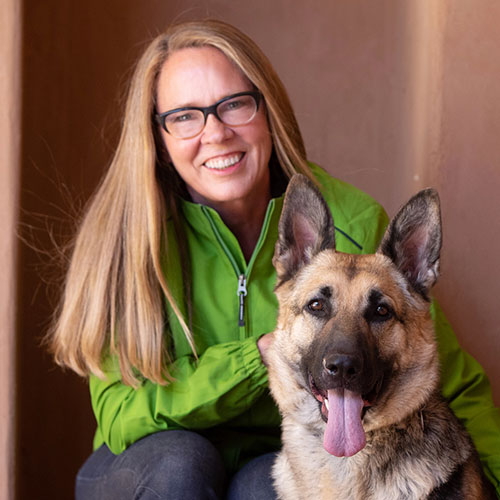
Julie Castle
CEO, Best Friends Animal Society
Everyone wants to work smarter and more efficiently, but my question is, “Can this be used to help us save more lives?” If the answer is yes, then I believe we have a responsibility and even an obligation to explore and utilize that potential for lifesaving.
Progress in shelters today
Over the past decade, we’ve made extraordinary progress toward ending the killing of dogs and cats in shelters across our nation. Today, more than 2 out of 3 shelters have reached no-kill, meaning they are saving at least 90% of the animals that enter their care. Tens of thousands more pets are alive today than would have been just a few years ago.
We’ve come a long way, but still, every 90 seconds, a shelter pet is being killed for the lack of a home. The question we need to ask ourselves is not whether we can do better, but how quickly we’re willing and able to find lifesaving solutions. That’s where the potential and power of artificial intelligence comes in.
Putting AI to work
At Best Friends Animal Society, we’ve already begun using AI to help answer complex questions that can shape policy, remove barriers, and accelerate the saving of lives of dogs and cats.
Take one long-standing assumption: that people who rent their homes are more likely to relinquish their pets at a shelter than homeowners. It’s a belief that has quietly influenced adoption decisions for years, often making it harder for renters to adopt pets.
We recently analyzed the pet intake records from a major municipal shelter, nearly 100,000 in all. Processing that volume of data would typically take weeks or months of staff time. Instead, one of our team members used an AI tool to analyze the data in a matter of hours.
The result? There was no meaningful difference in the rate at which home renters surrender their pets to a shelter as compared to homeowners. That insight matters. It allows shelters and rescue groups to remove any unnecessary barriers targeting people who rent their homes, which in turn opens the door for more people to adopt. When barriers and hurdles to adoption are removed, more lives are saved.
In another test run of AI’s ability, we were able to map clusters of complaints concerning outdoor cats. With that information, volunteers can canvass homes in the identified neighborhoods to offer spay/neuter and other support, which in turn reduces nuisance behavior, helping people live more peacefully with the community cats. Again, a seemingly impossible task was completed in a matter of hours with AI. All we needed was to know what questions to ask.
From assumptions to evidence
This is the real promise of AI in animal welfare. It allows us to move from assumptions to evidence-based actions and policies, from isolated efforts to system-level solutions, and from reactive responses to proactive strategies.
Over the course of my career, I’ve never lost sight of the individual animal, because that’s where my journey began. I’ve also come to understand that saving lives at scale requires us to think and act differently, and AI gives us the ability to see patterns we couldn’t see before, to test ideas faster, and to make smarter decisions that help accelerate solutions.
Of course, AI will never replace the human heart at the center of this work. It won’t comfort a frightened animal, build trust with a family in crisis, or open a home to a shelter pet, but it can help us do all of those things better.
If it can help us get to a day when no healthy or treatable pet is killed in a shelter, then it’s not just a tool worth exploring. It’s one we can’t afford to ignore.
