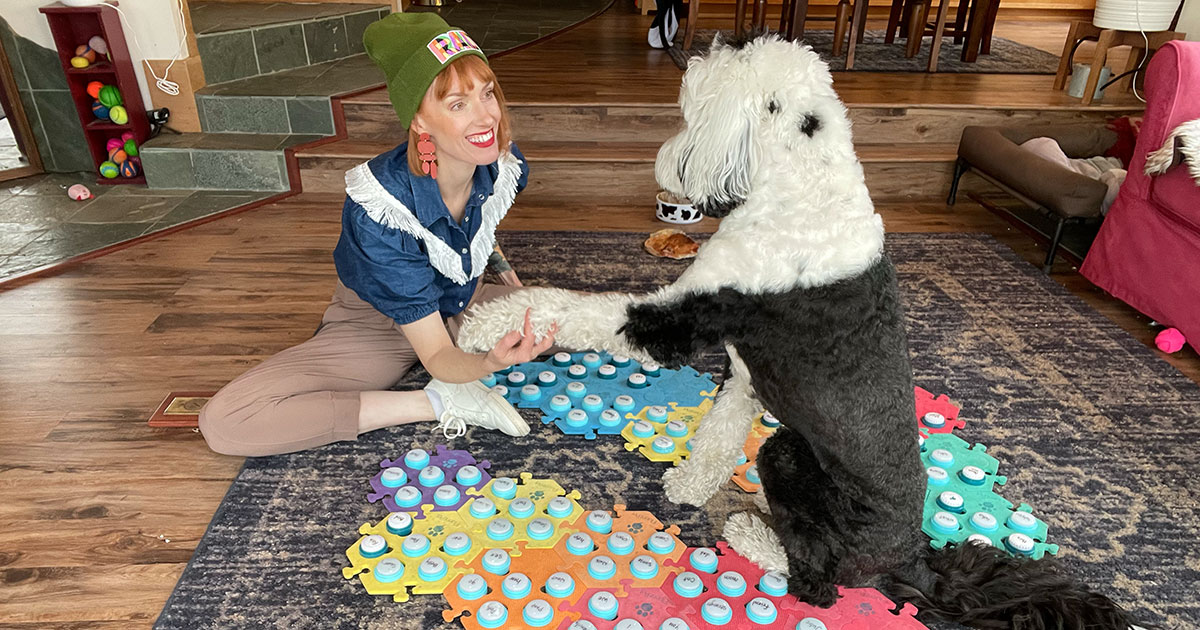
Alexis Devine, the owner of viral talking sheepadoodle Bunny, opens up about button training, canine cognition, and the role enrichment plays in pet wellness.
What does a typical day in the life of Bunny look like?
Bunny’s typical day has both structure and flexibility. One nice aspect of using a button system with her is that she can control the flow of her day to some extent. We usually enjoy slow mornings while I work, followed by a long walk in the wilderness with her brothers, then a meal and some enrichment, followed by naps for the pups and more work for me. We’ll spend some more time outdoors in the early evening, playing or just wandering. Sometimes I scatter her meals on the ground to engage her foraging instinct. After that, we’ll relax until bedtime. The pups will get a chew, and I’ll watch a movie. Snuggles will ensue.
Bunny is known on social media as a “talking dog.” How did that experiment start?
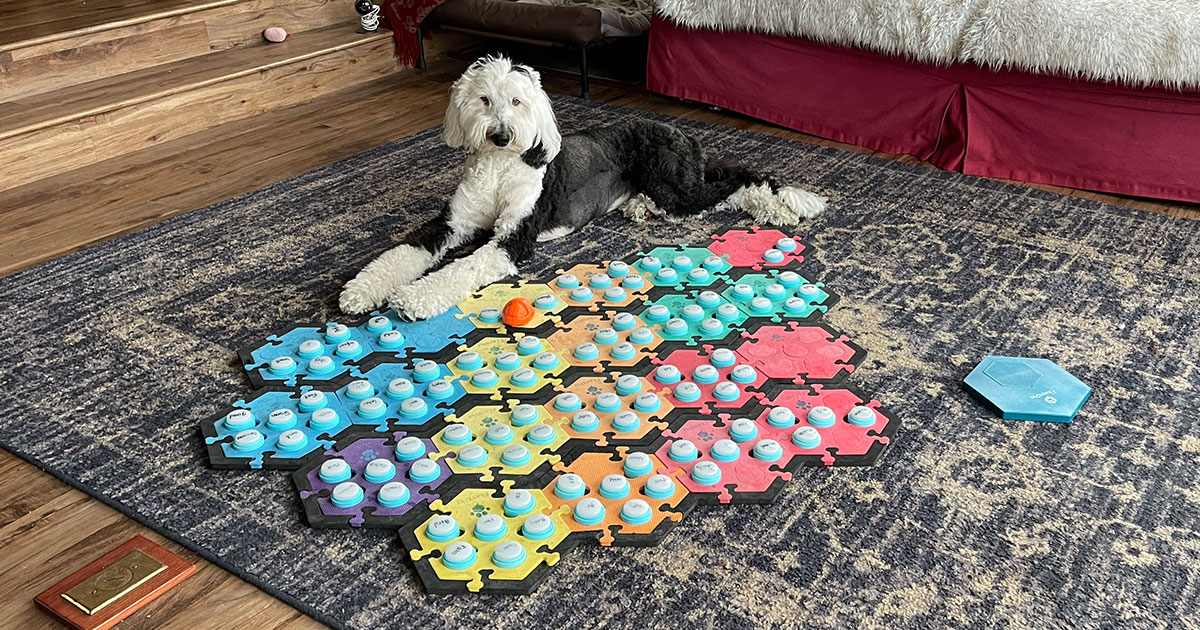
Before bringing Bunny home, I decided that I wanted the closest relationship and clearest communication possible with her. I’d seen buttons from speech-language pathology being used with another dog and decided I wanted to give it a shot. I imagined that if I were successful, it could help us move through the world more as partners than as owner and pet. I had no idea what I was doing, but she took to it quickly. It wasn’t long before I began to see the positive behavioral and emotional impact that buttons were having on her life and our relationship. I started with an “outside” button, and within a few months, we had dozens more buttons and were exploring concepts like emotion and time. She became the pilot dog for the largest ongoing citizen science canine cognition research study ever attempted.
What are some of the biggest misconceptions about dog intelligence?
Dogs have distinct cognitive profiles. Some excel at memory, others excel at social cognition or inferential reasoning. Intelligence in dogs is multi-dimensional. As humans, we tend to measure the intelligence of other animals against our own, but this is a flawed benchmark. When we ask “How smart is a dog?” what we’re really asking is “How human-like is a dog?” This means we risk ignoring the unique intelligences that dogs possess. In fact, these unique and specific intelligences enabled our 40,000 years of co-evolution. Dogs have been naturally and artificially selected for their ability to communicate and cooperate with us. This is why we now have bomb-detecting, cancer-sniffing, livestock-protecting, herding, mushroom-hunting, and psychiatric service dogs, among so many others. Our combined intelligence creates a playground for exceptional partnership, yielding outcomes greater than the sum of its parts.
What role does mental stimulation play in pet wellness?
Mental stimulation and other enrichment activities are crucial to welfare. Dogs deserve to engage in doggy behaviors, and many modern environments aren’t set up to support that. Enrichment can take many forms, such as trick training, personal play, a sniff walk, or a shred session; we want our dogs to be able to engage in as many species-typical behaviors as possible. Some of these behaviors include foraging, sniffing, digging, shredding, and hunting. When we provide safe outlets for these behaviors, we not only enrich our furry friends’ lives but may also reduce behaviors typically deemed problematic. A win-win.
How can training enhance a pet’s confidence?
Just like learning a new skill as a human, mastery and competence produce measurable emotional responses. Using positive reinforcement training and rewarding successive approximations of a desired skill builds a history of capability. Small wins adding up over time create predictability, which reduces anxiety. When a dog discovers that its own behavior can control outcomes, we create contingency awareness. The dog learns that she has agency. With agency comes confidence.
What advice do you have for pet parents who are interested in introducing enrichment activities to their pets?
Enrichment comes in endless shapes and sizes, and it doesn’t have to be complicated. A frozen lickmat can work wonders. Understanding the individual is key. What matters to your furry friend? What do they enjoy? What aspects of “dog life” are currently unavailable to them? Can they be off-leash periodically? If not, consider a Sniffspot. Do they have the opportunity to scavenge? If the answer is no, hiding some kibble around your home could be a fun enrichment game. When was the last time they shredded something? A cardboard box with a couple of treats or a head of iceberg lettuce are great options. Even just a walk led by your dog’s nose. It’s important to remember that our dogs ultimately determine whether something is enriching or not, so use this as an opportunity to slow down and enjoy how your best friend experiences the world.
