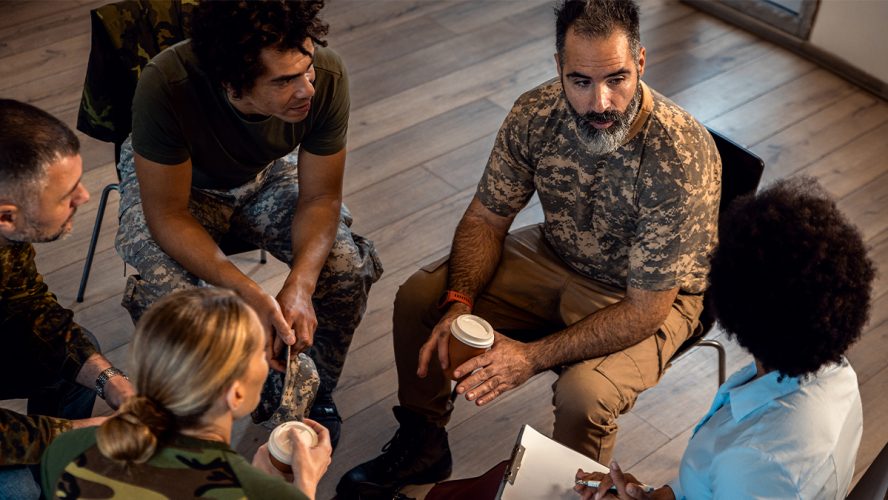
Veterans commonly face challenges assimilating back into society post-service. Destigmatizing and normalizing mental healthcare and crisis intervention and support can make a lifesaving difference.
We often think of military leaders as invincible. I once served under a Major General who embodied that image — charismatic, strong, larger than life. He mentored us, empowered us, and made us believe we could overcome any obstacle. A few years later, after his retirement, he seemed to be thriving. We exchanged several messages about his own transition, and I was excited to reconnect with him further to chat about my own upcoming adventure. Then, only a few weeks later, came the devastating news: he had taken his own life.
That loss shook me to my core. If someone who had carried so many others could not find a way forward, what did that mean for the rest of us?
When I transitioned out of the military, I faced my own struggles. On the surface, I looked like a success story — retired, employed, moving forward. But inside, I was battling medical issues, the disorienting pace of civilian work, and an unraveling of my confidence. In those dark moments, I thought back to my mentor and wished he had reached out. That wish became my turning point. I called 988, the Veterans Crisis Line, and sought help.
Here’s the truth: asking for help saved me. It gave me the space to rebuild, to pursue graduate school, and to redefine my mission outside of uniform. And it reminded me of something every veteran needs to hear: strength is not silence. Strength is reaching out.
The reality many veterans face
My story is not unique. Data shows that the transition home is challenging for a significant number of veterans. According to the Pew Research Center’s 2012 report “Many Veterans of Post-9/11 Wars Face Difficulties Returning Home,” 44% of post-9/11 veterans said re-entry into civilian life was difficult, compared with 27% of pre-9/11 veterans. The struggle is even more profound for those who experienced combat: 51% of post-9/11 combat veterans reported difficulty adjusting, versus 34% of those who did not serve in combat.
These numbers underscore something critical. The challenges many of us face are not personal failures — they are common, documented, and deeply human responses to major life change.
And the period immediately following separation from service is especially challenging. Research from the Department of Veterans Affairs highlights that suicide risk in the first three months after leaving the military is nearly three times higher than for active-duty service members. This window of vulnerability is exactly why early intervention, outreach, and connection are vital.
Why asking for help matters
We must dismantle the dangerous myth that resilience means carrying the weight alone. In the military, problems are often solved by reassignment or a new mission. In civilian life, those options don’t exist. Veterans are left to navigate challenges where they are — and too many feel trapped. That’s why support systems like the Veterans Crisis Line are not optional; they are lifesaving.
But support doesn’t stop there. Veterans have multiple pathways to seek help:
- Immediate crisis support is available through 988 (press 1), by texting 838255, or chatting online.
- VA medical centers provide emergency mental healthcare — even for those not enrolled in VA healthcare — and every center has a Suicide Prevention Coordinator.
- Vet centers offer confidential counseling for combat veterans and their families, helping with the transition to civilian life.
- Community and peer networks like Wounded Warrior Project, Team RWB, and Disabled American Veterans create spaces where veterans can connect with others who understand their struggles.
- Practical assistance is available through the Veterans Benefits Administration for disability claims, job training, and education, while nonprofits provide housing, employment, and healthcare support.
These resources are not signs of weakness — they are lifelines. And we must normalize their use. Leaders, peers, families, and communities must remind veterans that their lives matter, that their value does not end with their service, and that vulnerability is not weakness — it is courage.
My mentor’s story ended in tragedy. Mine did not, because I reached out. If there is one message I want to leave with every veteran, it is this: You are not alone. Call. Speak. Share. Your life matters, and asking for help is the bravest mission you will ever undertake.
