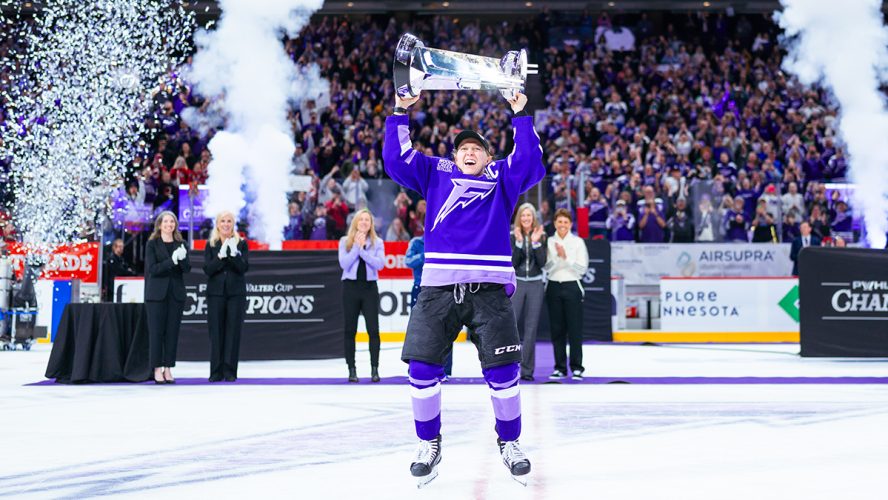
As a captain in the Professional Women’s Hockey League, Kendall Coyne Schofield knows effective leadership for women in sports means trusting your instincts and making long-term decisions that position the whole team to keep winning.
When did you become aware of hockey’s perception as a “men’s sport,” and what impact did that have on how you approached your career?
For as long as I can remember — from not seeing many girls playing the sport to other parents telling mine to sign me up for sports that “normal girls play” to being called names like tomboy and getting my hair pulled during games — it was early on that people were trying to convince me that hockey wasn’t a sport for me. It was for boys.
Growing up, I would go to the Chicago Blackhawks games where I started to realize there were never any women on the ice. I then realized there was no existence of women’s professional hockey. But when I met Hockey Hall of Famer and Olympic gold medalist Cammi Granato after the 1998 Olympics, I had my “see it, be it” moment, and my goal to play in the Olympics was born.

Why did you commit to making player advocacy a central focus of professional women’s hockey?
We started the Professional Women’s Hockey Players Association (PWHPA) in May 2019 on the premise of Ilana Kloss and Billie Jean King’s advice to create one voice. We did so by forming this players’ association, because the voices of 200 of the world’s best players speaking as one was a power that couldn’t be stopped.
As a player, advocate, and now captain within the Professional Women’s Hockey League (PWHL), how has your understanding of leadership evolved through the process of helping build a league from the ground up?
Leadership is hard and can be lonely. Being a leader means not making everyone happy but trusting your instincts to know your decisions are to position everyone for success. Being a leader means taking care of others while still finding a way to prioritize your needs. I have taken bits and pieces from the incredible leaders I have been able to learn from and formed my leadership style in that way.

What has it meant to you personally to step onto the ice in a league that was shaped in large part by player involvement and advocacy?
I am incredibly proud. I feel empowerment and relief. No matter how big the challenges, I always believed my fellow athletes and I could make a living playing the sport we love.
What advice would you give to young women who love sports but don’t yet see a clear future for themselves in them — as athletes, leaders, or decision-makers?
Living the dream is one thing, but building the dream is another. You first need to see and understand what you want to achieve and have the drive to change the landscape. My advice is: By all means, go for it!

Looking ahead, where do you see the biggest opportunity for growth in women’s hockey, and how can players, leagues, and fans continue to push the sport forward together?
To continue to attract the world’s best players to the PWHL and to draw larger and larger audiences to these events. We want the PWHL to be the premier league for women’s hockey in every way; we now have a clear path to get there. I can’t wait for our first million-dollar player contract. Imagine that!
