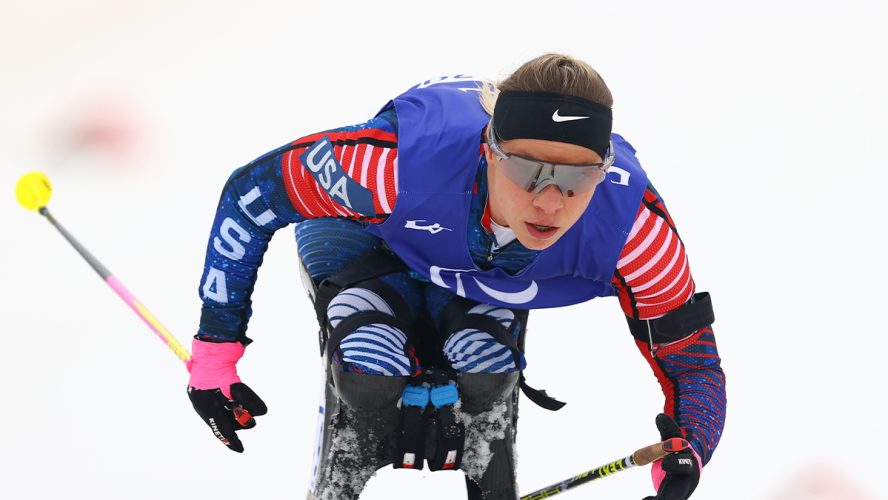
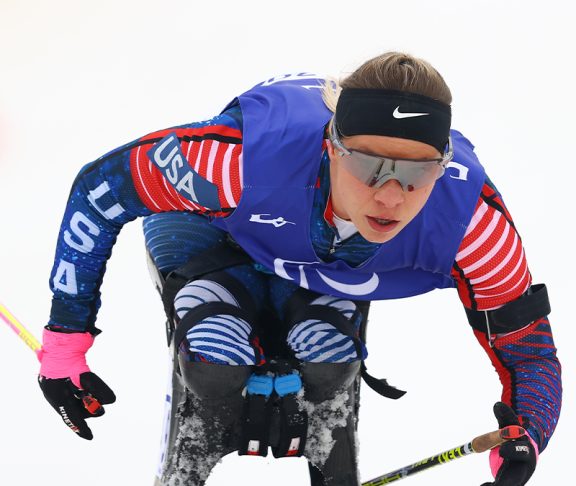
Nineteen-time paralympic medalist Oksana Masters knows what it means to show up for yourself. Growing her skills without relatable disabled athletes fueled her desire to excel in sports and set an example for future generations of what athletes look like and can do.
What made you fall in love with sports?
It started in Buffalo, N.Y., when I was ice skating, and then in Louisville, Ky., when I got into rowing. I’m very competitive by nature, whether it’s a board game, cooking eggs, or whatever it is, I’m just competitive.
I just love that aspect of competing against the best and trying to bring out the best in yourself. And then I think for me, as someone who grew up not knowing sports was something I could be an athlete and never saw myself as an athlete. It gave me that identity. It showed me how powerful my body still is, regardless of how society might view it.
How has your relationship with sport evolved throughout your life?
I think the relationship evolved just for fun — making friends, learning the language, because I didn’t even speak English at that time. It went from one day a week to six to seven days a week of training. In my teenage years, rowing was my therapy. It was my escape. It was my place to process a lot of mental things and heal emotionally and mentally. Then it got to wanting to just be better and better.
Now this stage is my favorite. I saw how hard it was for me to be recognized as elite, but then also the access to elite equipment. I saw the financial barriers and what was preventing me. So now I want to break society’s mold of what athletes look like and what it means to be an athlete. I have my personal goals, but it’s for a generation behind me coming up.
Was there a specific moment you can point to as your “biggest” in your identity as an athlete?
There are two. When I transitioned to cross-country skiing in 2014 and I won my first individual paralympic medal. Standing on the podium with a silver medal, I realized that I belong on this stage. And the second, in 2018, when I broke my elbow right before going to the games. I was expected to win all of my events. Racing with that broken elbow and still winning my first gold medal showed that I am not one to give up.
Can you recall a time when another woman, an athlete, a mentor, or a teammate helped shape your confidence or direction in sport?
When I got into sports, I didn’t have that. I didn’t look up to someone, because they were fully able-bodied, and it was hard for me to see myself in them. And not having that role model, not having that mentor, that’s why I’m part of Sisters in Sports Foundation. As I transitioned, through partnerships, I met athletes I admired. Mikaela Schiffrin is one of those people. To meet her, have her look at you in your eyes and understand the challenges to being a paralympic athlete, that meant a lot. And also Lindsey Vonn. They’re always saying, “That’s incredible.” That also has helped me have that confidence within myself too.
How do you hope your story impacts girls who may be facing barriers in sports?
I hope they realize to not compare yourself to the person next to you in your journey, in your timeline. Find that thing that you love. I didn’t make my first national team for a long time. I didn’t get my first gold medal until my fourth paralympic games. It’s to not compare yourself to other timelines and journeys. Never count yourself out and just always keep showing up for yourself. Keep showing up for that “why.”
What is your “why?”
I have so many. One of my biggest “whys” is my mom and my family. She never gave up on me. But in addition to that, it’s the next generation. Specifically girls and women with disabilities. I want to break the barriers of access to sport and how society views what women’s roles are, who we can become, and what it looks like to be strong, successful, fierce, and powerful.
I wasted so many years looking in the mirror not knowing who I was, because I let outside voices determine what was possible for me. That’s something I don’t want the next girl, boy, person to go through. It’s showing what’s truly possible, and there’s no right and wrong way to line up on the start line and chase your dreams.
Was there a moment where you realized the importance of your visibility and representation as a woman in sports?
I saw the power when I chose to show my legs and no longer hide the things that make me me. I got a message from a parent of a little girl who had one leg above the knee and always hid it. After seeing my story, the next morning she wore a dress to school and didn’t hide it. That’s when it hit me — the power of visibility.
