From the women who first paved the way to the award-winning and esteemed journalists of today, passing the torch through generations ensures women remain represented in all facets of sports media.

Dave Goren
Executive Director, National Sports Media Association (NSMA)
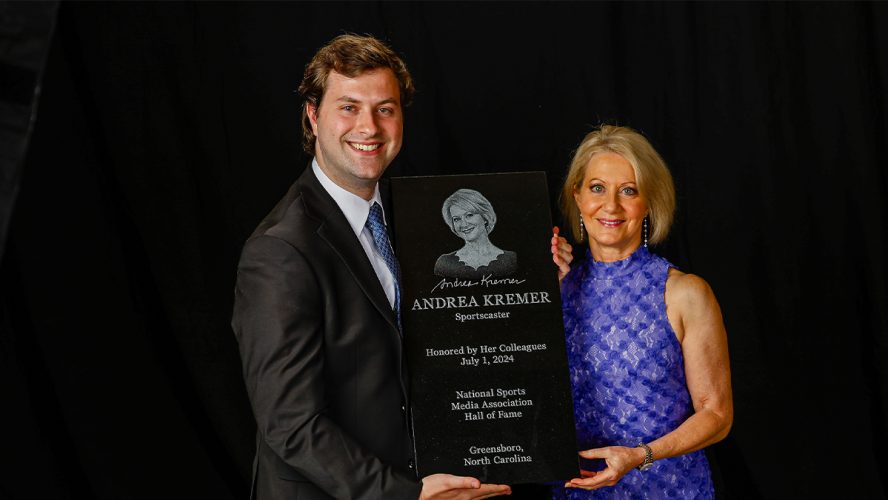
During my 17 years at the National Sports Media Association (NSMA), previously known as the National Sportscasters and Sportswriters Association, I have been fortunate to see the inductions of Lesley Visser, Linda Cohn, Jackie MacMullen, and Andrea Kremer into our Hall of Fame.

You might say, “But that’s only four women in 17 years.” While true, it’s important to know history. During World War II, Mary Garber moved into sports at the Winston-Salem Journal only because sports staffers had been recruited to military service. One of the true sports media pioneers, Garber wrote for the Journal for nearly 60 years and was inducted into our Hall of Fame in 2008.
Paving the way
Before the cable tv sports explosion of the 1980s, there were not many women working in sports media at all. Those who did typically played secondary roles. Many of the women who rose to prominence on television began as sportswriters — Visser, MacMullen, and Kremer all fit that bill.
Beginning in 1979, ESPN, the first 24-hour sports tv channel, provided the need for more programming and, with it, the need for more on-air talent. That opened the door for more women, with Rhonda Glenn the first woman to appear on ESPN, followed by Gayle Gardner, and many others.
In 1991, Heidi Soliday became the first female sports director at a local tv station, KCCI-TV in Des Moines, Iowa. In the intervening 35 years, women have become sports media mainstays. While admiring the role models who came before them. Visser said at a Women in Sports forum during the National Sportscasters and Sportswriters Association (NSSA) Awards in 2011, “If I get one more ‘Pioneer’ award, I’m going to start wearing a coonskin cap.”
Continuing the path forward
Today’s women have grown up playing sports. Title IX created opportunity. Funding increased. And now three generations of young girls playing sports have become women who read about, watch, and listen to sports.
There is, however, still plenty of room to grow. Statistics for 2010–2021 cited in a Zippia survey showed that there were four times more men working as sports journalists than there were women, with the percentage wavering slightly over the length of the study. One can’t help but wonder if the number of women has increased since 2021, keeping pace with the increased consumption of live women’s sports.
Whatever the numbers show, there is no argument that women’s voices have helped drive a more diverse industry that ensures more inclusive storytelling.
